

The Making of a Jewel
"I was the kid that was always artsy and introverted. I'd never thought I'd end up making beautiful jewelry as my career. It was the last year in my college days when I took up a class in "The History of Jewelry" where I was introduced to the long history of self-adornment. This was also what inspired me to go down the route of jewelry design. From the Byzantine period to the Rococo period, the idea of using jewelry as self-expression had been the reason of why we wear jewelry. I fell in love with the idea of turning my vision into a sparkly beauty, and to share that beauty with you."
- xx Tippy

|
INSPIRATION
Every little pieces of life sparks an inspiration for the collection. From there we start pulling more inspiration, and uncovering new elements to add to the designs.
|
GEMSTONE, METAL, TEXTURE
After a rough idea surfaces, the next step is envisioning what kind of feeling we want the piece to embody. This feeling is portrayed by the materials we will be choosing, such as the metal color, gemstones (shape, colors, cuts). All of which makes up the texture of the piece. We feel the gemstones, and play around with different gemstone cuts to see how they would look on the fingers. |
 |

|
SKETCH
Knowing the inspiration, "feeling" and artwork we have to work with is key when we start sketching. The design goes through many iterations throughout the day, and sometimes for months (because good design takes time right?) before we transfer it to our computers to play with it more until we decide on a final design. |
COMPUTER MODELING
|
|
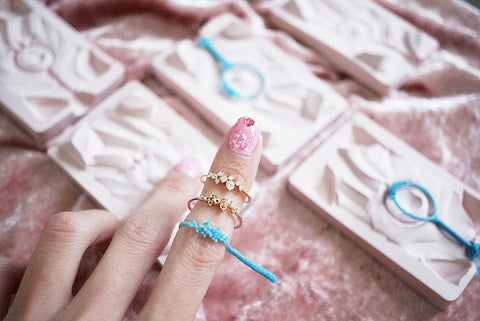
|
PRODUCTION
|
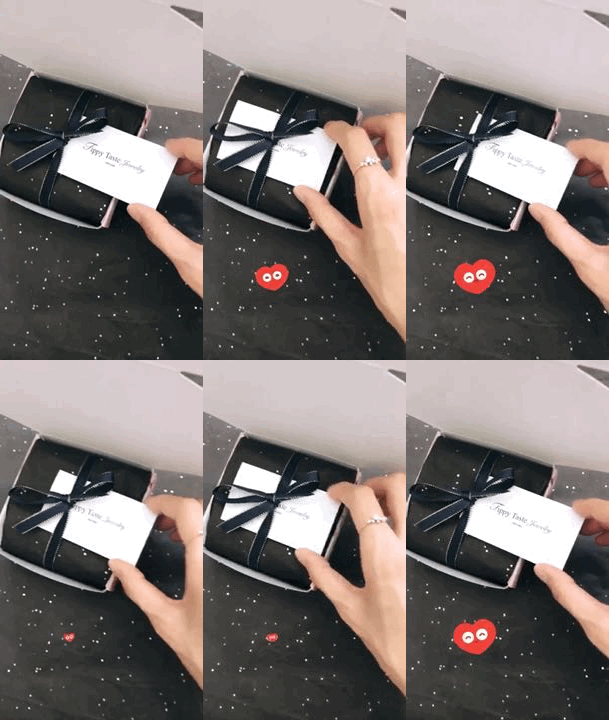
JUST FOR YOUThen we share all of our hard work with you! Once we receive your orders, we ship out each order with love, care, and a big bow. We hope you love our pieces as much as we enjoyed making it for you :) |
 |
Craft & Process
The Making of a Jewel
Every Tippy Taste jewel begins with something small: a stone, a line, a reference. What follows is a slow process of drawing, refining and making, until an idea becomes an object that can be worn.


The Idea
It Begins With an Idea
A design can start almost anywhere: a gemstone with an unusual color, the tracery of a cathedral window, a painting, the curl of a leaf, or simply a silhouette that feels right on the hand.
Ideas are drawn first, by hand, and many are drawn again and again before one is kept.


The Stone
Led by the Stone
Often the stone comes first. Natural gemstones are never uniform: color can drift across a single stone, inclusions leave their own marks, and an unusual cut or proportion may not suit a standard setting.
The design is shaped around those qualities rather than in spite of them, so that no two stones lead to quite the same jewel.
“We feel the gemstones, and play around with different gemstone cuts to see how they would look on the fingers.”
From the Tippy Taste studio
The Drawing
From Line to Form
A sketch becomes a jewel only when its proportions work in three dimensions. The line is refined for balance and profile, for the way the center stone sits against the gold around it, and for how the piece reads from the side as well as from above.
For the Manhattan Diamond Pear Ring, numerous sketches were drawn before two designs were chosen.

Pencil studies for the Manhattan Diamond Pear Ring, 2018.

The finished ring.

A design rendering, from the studio archive.
The Setting
Building the Architecture
At Tippy Taste the setting is part of the jewel, not simply a mount for the stone. Negative space, the rhythm of claws and diamonds, the curve of a shoulder and the profile of the ring are drawn as carefully as the center itself.
Tracery

Gothic Marquise: gold drawn from cathedral windows.
Ornament

Heart of Provence: scrollwork framing a bicolor sapphire.
Profile

Ocean: an open band that rises toward the stone.

The Metal
Formed in Gold
Once the design is resolved, it is made in 14K or 18K solid gold.
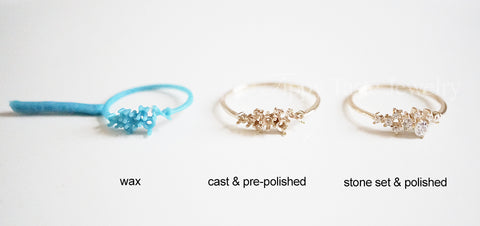
The studio archive shows the stages one ring passes through: a model in wax, the first casting, and the finished piece with its stones set and polished.

The Finish
Set & Finished
Then the stones are set and the gold is polished and finished, until the surface and every claw sit as they were drawn.
Each piece is made to order in our New York City studio.

The Jewel
The Finished Jewel
What began as a line, a stone and a question of proportion becomes an object with weight and presence: something to be worn, and kept.
Made for Its Collector
A Tippy Taste piece is made for one person at a time: made to order, or, for One of a Kind, made once and never repeated. It is meant to become personal, worn into a life rather than kept behind glass.
